Translate

Showing posts with label nature on the loose. Show all posts

Monday, May 25, 2015

Ancient Cult Files #4 -- Prophecy

   John Frankenheimer is a widely acclaimed film-maker who throughout his career has made social drama and action/suspense films that have brought challenging political situations and historical happenings to the forefront. In the year 1979, he made a film that provided a provocative story-line involving the treatment of American Indians and the consequences of having industrial factories in a world that did evolve with their pollutants, in this case paper production. Now, in what way can those two themes be woven together in a plot that intersects properly on all critical levels?
   Add in a mutant grizzly bear of course!
   Prophecy was released in 1979 by Paramount Pictures and starred Robert Foxworth, Talia Shire, and Armand Assante, along with a supporting cast of Victoria Racimo, Richard Allen Dysart, and George Clutesi. The plot is set in Maine, even though grizzly bears don't actually live in that region at all.
   The story begins with Robert Verne (Foxworth), an inner city doctor that has become cynical from dealing with poverty stricken patients, taking a job with the Environmental Protection Agency to do a report on a forest in which the interests of the Native American residents and a nearby paper factory are butting heads. The conflict has apparently turned violent and the situation will soon completely spiral out of control without a federal ruling. He travels to Maine with his
Maggie Verne, Isely, and Dr. Robert Verne
wife Maggie (Shire), who has recently discovered she is pregnant and is afraid to tell her husband since he is strongly against having children after seeing so many emaciated families in his previous line of work.

   The Verne's are greeted by paper mill director Bethel Isely (Dysart) who explains that all the conflict is over the acquirement of a large sum of the forest for logging for the paper mill. This area of forest is part of the traditional homeland of the Native Peoples, or Opies (a shortening for Original Peoples), and that they have been the perpetrators of the violence after refusing to let the loggers through. He says that radical members have even committed murder on some of the mill's lumberjacks and the search crew sent to find them after the fact. They encounter some of the Opies guarding the entrance to the forest, lead by John Hawks (Assante) and his wife Ramona (Racimo), and a vicious fight ensues. Both Verne and Maggie are horrified by the level of hostility between the two parties.
A mutated tadpole
   Maggie attempts on several occasions to tell her husband that she is pregnant, but is continuously interrupted by the strange goings-on in the forest. There are salmon large enough to swallow ducks, a raccoon without rabies seeking to kill people, and various other abnormalities in the ecosystem. 
   Hawks and Ramona eventually persuade Verne and Maggie to come and see their side of the story; the state of the Opies suggests that some sort of pollution has been causing increased mental illness, stillbirths, and children born with mutations in their people since the time the paper plant was built. This seems to be linked to other strange growths in the forest since both the Opies and the wildlife get the majority of their food from the river, which the paper mill uses to float their lumber down to the factory. They also hear the native legend of the coming of Katahdin, a mythic spirit guardian of the forest, from Ramona's grandfather (Clutesi) who claims that the deaths of those in the woods were the deity acting in protection of their natives lands.
   Verne soon discovers that the paper mill has been using Methyl Mercury as an anti-fungal agent for logs they must store before processing. This acts as a mutagen to the entire food chain of the river system and has been know for causing devastating mutations over time, and even eating a small amount of an animal that contains the mutated genes will effect pregnant creatures. This dismays Maggie, who ate a fish Verne caught earlier in the film.
Mutant bear cub
They go to investigate the scene of more murders in the forest and discover two mutated bear cubs washed away in a storm, one of which is still alive. They conclude that the mother of these cubs has been committing the murders and Verne becomes determined to keep the lone cub alive in order to provide evidence of the paper mill's pollution. However, the mother bear attacks the group and kills mercilessly trying to recover her baby. The rest of the film revolves around the characters struggle to make it back through the woods alive.
   Prophecy did not earn back what it cost to make, and Frankenheimer noted that this film was without a doubt the lowest point in his career (during which time he was struggling with alcoholism). To be frank, it's hard to argue with him.
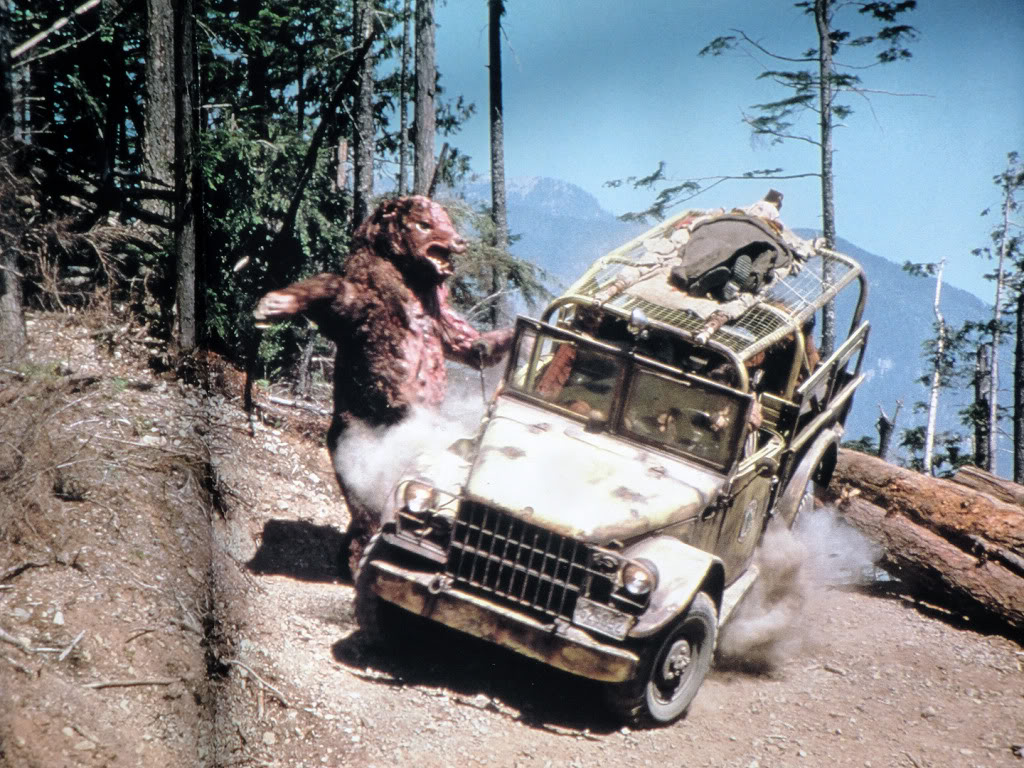
Katahdin (mutant grizzly mama)
   While the plot has some good ideas (mutant bear in the woods with no where to hide), it seems to suffer from poor pacing and predictable script choices. It takes far too long to see the monster (an entire hour in fact) and when they finally reveal the beast, it is such a ridiculous kill scene that you can't help but laugh. The sub-plot with Maggie's pregnancy takes far too long to play out as well; most of Shire's screen time is her looking dreadful of revealing her secret to her husband, and by the time she finally does, we've been begging her to for the last half hour. The creature effects are a bit goofy, but honestly its good to have a laugh after being subjected to the boring affairs of the human characters for the majority of the film.
   The redeeming factors of the film are the beautiful scenery (shot in British Columbia, Canada) and the (few) moments of atmospheric tension. The scariest scene in the whole movie to me is when the characters are in a underground shelter and just listening as the
The Verne and Hawks couples waiting in fear
monster is heard above ground destroying the campsite and murdering the remaining people. No one says a word and they all just stare at the ladder leading to the surface, and we find ourselves wondering the same as their faces convey; can it get down here?

   But other than those few moments of enjoyment, the movie is quite slow, and sometimes you forget you're watching a horror movie, until the bear just shows up out of the blue. Perhaps the greatest legacy of this film was that the creature Katahdin was the inspiration for South Park's ManBearPig. 
   All and all, if your really into monster movies and want a truly unique monster, Prophecy delivers (after the first hour of course). This film may also be fun to view at one A.M. when you have absolutely nothing else to watch, but otherwise, you may want to choose something a bit more exciting.
   Two and two-thirds of a star, check it out if you're really interested!


Human road kill

Sunday, May 10, 2015

Ancient Cult Files #1 -- Phase IV

   Saul Bass, a widely recognized figure in the film-making sphere, is best known for his unique talent in the creation of film posters and film credit sequences. He also is the graphic designer responsible for some of the most easily recognizable corporate logos such as Geffen Records, Quaker Oats, Girl Scouts of USA, and AT&T and worked alongside other titans of cinema such as Alfred Hitchcock.
   He only ever directed one film, and he teamed up with over 1000 extras to complete it.
   Phase IV was released in 1974, it starred Michael Murphy, Nigel Davenport, and Lynne Fredrick, along with all the ants which are the true main characters of the film. 
   The story begins with unknown big-bang scale event in space, which triggers a change in one of the living species on earth, but they were so small the no one noticed. This galactic phenomenon causes the ants in a region of the Arizona desert to alter their behavioral structure all together. Their progress is listed in "Phases"; they first begin to meet as though they are representatives in the United Nations, ignoring their usual ecological niches of trying to kill each other to survive. But instead the various species of ants begin to use each other's skills
Ant skyscrapers
to make a more prominent and cohesive race of insects. Only one queen ant is ever shown, and it is unclear if she is the queen of all the ants or rather just one queen of one of the colonies in the new ant-world order. Under their new societal system, they build more elaborate and efficient homes (skyscrapers made of dirt) and begin to slowly take over the surrounding ecosystem. By the time the human characters show up, they have entered "Phase III". Michael Murphy plays James Lasko, who is a specialist on communicating with animals through sound and geometric means (who only had success with emotionally disturbed killer whales, perhaps at Sea World) and is summoned by Dr. Ernest Hubbs (Nigel Davenport) who has been sent to study the ever-expanding ant super-society. 

The scientist's dome
   The ants have mostly run out any residents in the area, so the scientists are working alone in their dome-shaped laboratory equipped with all the essentials for their stay and high powered computer (state of the art 1970's computer).
   Dr. Hubbs decides to provoke the ants to see their reaction, which angers them and they attack the farm of the only family left in the area, including young Kendra (Lynne Fredrick) and the family attempt to flee to the scientists lab. The scientists investigate the next morning and discover Kendra's family dead along with the ants after battling with the swarm all night, but the girl unharmed after taking shelter in a nearby abandoned home. They take her into the dome for protection, since they know the ants are regrouping and will be back.
 The rest of the film details the battle of wits which ensues; Dr. Hubbs becomes hell-bent on proving his superiority over the insects, Lasko trying to communicate with them, and a traumatized Kendra trying to
Dr. Hubbs, Kendra, and Lasko
deal with her grief and anger over her family's death. However, the ants always seem to be one step ahead of the humans in some capacity: they become immune to whatever pesticide they use against them, slowly but surely cripple their equipment, and test their powers of deduction with various messages that they send to Lasko. 

   The film is beautifully shot and has amazing close-up footage of the ants. The special photography of the insects was done by Ken Middleham who worked on several documentaries featuring such intimate camera work. The queen ant shown in the film is actually a female wasp; they could not use a real queen ant because getting one would be extremely difficult and the colony would perish in her absence. The acting is not the strongest, but all the actors do their jobs. The ants are arguably the characters we are meant to sympathize with. You see them come to a higher level
Rows of the fallen in battle
of consciousness in the opening, then watch them go through struggles that humans experience in warfare. The shot that best captures this eerie empathy is a scene in which the ants are laying out their dead as a result of the fighting with the human characters, much like what we see in real-world fighting in the media everyday. This parallelism with war is also seen in the characters themselves; Hubbs being the constantly defensive one, Lasko being the diplomat trying to forge any kind of non-violent relations, and Kendra representing the innocent who has been sucked into the torrent of conflict. None of their forms of coping with the situation can be successful because they continue to quarrel among themselves. The ants perhaps represent all that the human race could have been, and the human characters represent what it is, and now the ants have come to replace us. They operate as humans did upon our sudden jump in intelligence,
One of the film's many extras
slowly conquering each bit of the ecosystem until we could dominate almost every aspect of it.
   Another element of the film that adds to its aura is the soundtrack. It's a fine electronic atmospheric themed score done by David Vorhaus and Desmond Briscoe. In the sequences when it is only the ants, it turns into a style similar to that of the silent age, allowing the music to speak for the insects, only accompanied by the pitter-patter of their six little legs and occasional calls between ants. The ending of the film is like a lot of the plot, open-ended; it leaves the fate of humanity ambiguous, revealing only the end of the conflict between the characters in the film. The end also reveals the title, for this marks the end of "Phase III" and the initiation of "Phase IV" as the credits role.
   The film was a box-office failure and this partially lead to Saul Bass never directing again. However, the film has developed a cult-following thanks to a VHS release by Paramount and some television screenings, one being one of the early episodes of Mystery Science Theater 3000. Modern director Nicolas Goldbart has cited Phase IV as having a great influence on his own film making, and other film makers and also musicians have made homages to the film through their work.It has been criticized for putting the

Title card
cinematography and visual effects before the acting and script, and also for its unexplained plot threads throughout.
   I personally like the vagueness because it ignites the imagination to fill in the holes for yourself; was it an act of God, aliens seeking to destroy the earth, or simply evolution taking place that made the ants so intelligent? The film both provokes thought and entertains the immediate mind, making it a trip into a realm of unknowns; if we replaced the dominate species before us, then how long will our reign last?
   Phase IV is wonderful if you're in the mood for a stylistic science fiction head-spinner. It's also fun to watch with friends if you want to crack up about the, at times, lack-luster acting or the stupidity of the humans in comparison to the ants. 
   A solid four stars. Check it out.

"Go away, please go away." - Kendra